

Many business owners assume that installing a basic SEO plugin on their WordPress theme and publishing quality content is enough to rank locally. While these are critical first steps, building a local presence requires a vastly different strategy than traditional website optimization.
In 2026, Google’s local search algorithm considers strict, location-based factors like your Google Business Profile (GBP), business information consistency, online reviews, local citations, and geographic relevance when deciding which businesses to display in local search results.
If your awplife.com-powered WordPress site isn’t attracting nearby customers, there is a very high probability you are missing one or more of these crucial local ranking signals.
In this guide, we explain exactly why your WordPress website might be invisible in local search and provide actionable, practical steps you can take today to dominate your local market.
The Difference Between Local SEO and Traditional SEO
Traditional SEO focuses on improving your website’s visibility for broad searches, regardless of where the user is geographically located.
Local SEO is architected specifically to help businesses appear in searches with strict local intent, such as:
- Dentist near me
- Coffee shop in Chicago
- Emergency plumber in Austin
- Hair salon in Brooklyn
These high-intent searches often trigger Google’s “Local Pack” (the map and three business listings) alongside traditional organic results.
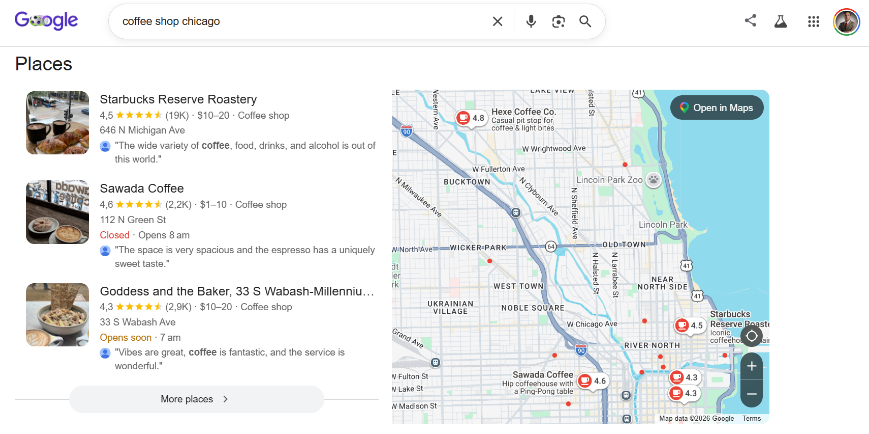
Common Reasons Your WordPress Site is Invisible Locally
If your beautifully designed website isn’t appearing for local searches, one or more of the following foundational issues could be bottlenecking your visibility:
- Your business information is inconsistent: Your business name, address, and phone number (NAP) must match perfectly across your WordPress website, Google Business Profile, social media accounts, and online directories.
- You lack dedicated location or service area pages: Businesses serving multiple cities or regions should create unique, optimized pages for each location instead of relying on a single, generic “Services” page.
- Your Google Business Profile isn’t fully optimized: Missing categories, outdated business hours, limited photos, or a generally incomplete profile will severely reduce your chances of appearing in Google Maps and the Local Pack.
- Your website lacks LocalBusiness schema markup: Structured data helps search engine crawlers definitively understand your business details, specific services, and exact geographic coordinates.
- You aren’t earning enough reviews or local mentions: Consistent positive customer reviews, local directory citations, and localized backlinks all help strengthen your local authority and prove credibility to Google’s algorithm.
How to Check if Your WordPress Site Has Local SEO Issues
Before making sweeping changes to your website’s architecture or content, it is vital to diagnose what is actually preventing you from ranking locally.
A comprehensive local SEO audit provides a complete picture of your online presence. It identifies technical crawl issues, incomplete business listings, on-page SEO gaps, citation inconsistencies, review performance, backlink opportunities, and other hidden factors that heavily influence local rankings.
Using SEOptimer’s great local SEO audit analyzes your website alongside your Google Business Profile, local listings, reviews, backlinks, and on-page SEO to highlight exact areas that need immediate attention.
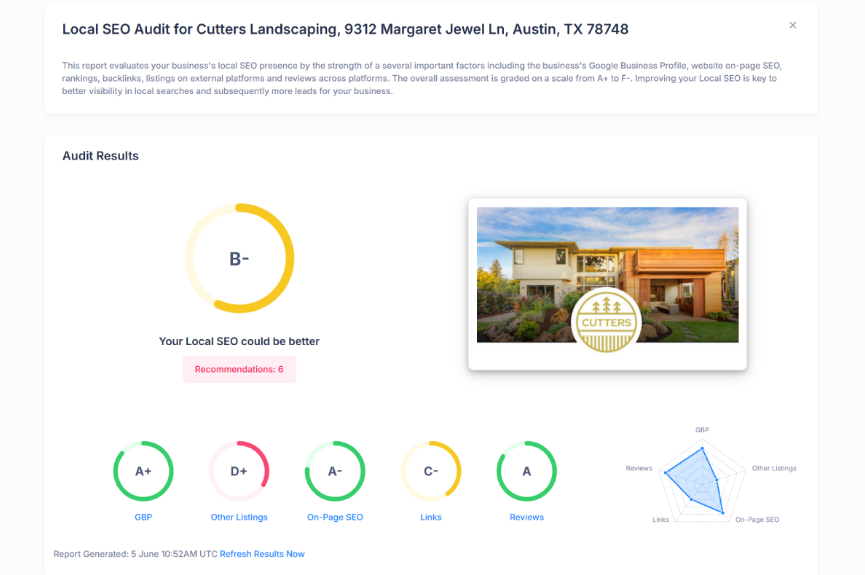
Instead of working through a massive checklist blindly, utilizing an audit allows you to prioritize the specific issues that will yield the highest return on investment for your local visibility.
How to Fix Your WordPress Local SEO Visibility
Add Clear Local Signals Across Your Website
Search engines should immediately understand where your business operates the second they crawl your site.
Display your business name, address, and phone number consistently throughout your WordPress website. The best practice is to place this information in your global footer and on a dedicated “Contact Us” page.
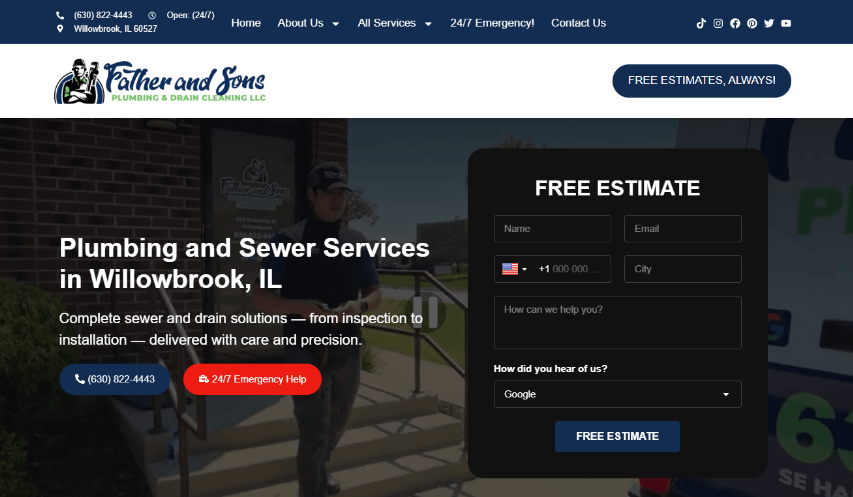
For instance, check how local service businesses successfully add the physical address of all their distinct locations directly in their website footer for maximum visibility. If appropriate for your business model, include your operating hours, specific service areas, and an embedded Google Map.

You should also mention your primary location naturally throughout your page content where it makes sense. This reinforces your geographic relevance without falling into the trap of keyword stuffing.
Build Better Location Pages
If you serve multiple cities or neighborhoods, create dedicated landing pages for each location instead of cramming every service area onto a single page.
To rank effectively, each local landing page should include:
- A unique, locally targeted introduction.
- Specific services available in that exact area.
- Local customer testimonials and case studies.
- Frequently asked questions relevant to that community.
- Mentions of nearby landmarks, roads, or neighborhoods.
- Clear driving directions (where appropriate).
- High-quality, localized images.
- A clear, accessible call to action (CTA).
Never duplicate the same content across multiple pages and simply swap out the city name. Google actively penalizes this lazy approach. Write unique, valuable content for every area you serve.
Improve Your Google Business Profile
Your Google Business Profile (GBP) is arguably the single strongest local ranking signal available today. To fully leverage this, align your profile with Google’s official guidelines for local ranking.
Complete every single section of your profile. This includes your detailed business description, primary and secondary categories, specific services, products, holiday opening hours, and contact details.
Upload high-quality, authentic photos regularly. You should also utilize Google Posts when you have company updates, special seasonal offers, or local events to share.
Crucially, you must respond to all customer reviews (both positive and negative). This demonstrates to both users and Google’s algorithm that your business is active, attentive, and engaged with the community.
Improve Mobile Usability
The vast majority of local searches (“near me” queries) now happen on mobile devices. Therefore, your WordPress website needs to provide a flawless, lightning-fast mobile experience that passes modern Core Web Vitals assessments.
Ensure your pages load quickly, your mobile navigation menu is intuitive, and your buttons are large enough to easily tap with a thumb.
Keep your contact forms short and friction-free. Most importantly, ensure your phone number is a clickable tel: link so users can call your business directly with a single tap. Remember, Google uses mobile-first indexing, meaning it primarily evaluates the mobile version of your awplife.com theme when determining your rankings.
Add Local Schema Markup
LocalBusiness schema is a form of structured data that speaks directly to search engines in their native language (JSON-LD).
Adding this markup to your WordPress site allows you to specify hard data—like your business name, address, phone number, opening hours, website URL, and precise business category—in a standardized, universally understood format.
Fortunately, you don’t need to be a developer to implement this. Many premium WordPress SEO plugins can generate and inject this schema markup automatically, making it incredibly easy to deploy on modern WordPress 6.5+ installations without touching a single line of PHP.
Create a Review Generation Gameplan
Online reviews directly influence both your local algorithm rankings and your potential customers’ buying decisions.
Instead of passively hoping for reviews, build review generation directly into your operational workflow. Send an automated follow-up email after a completed service or purchase, include review links in your team’s email signatures, or provide a branded QR code customers can easily scan in-store.
As mentioned earlier, responding to these reviews consistently is just as critical as collecting them. It proves to prospective clients that you value their business and sends positive, active engagement signals straight to Google.
Conclusion
Building a beautiful WordPress website using premium awplife.com themes is an incredible foundation, but it doesn’t automatically guarantee your business will dominate local search results.
Local SEO extends far beyond your website’s code. It encompasses external factors like your Google Business Profile, geographic signals, online reputation, local citations, and mobile performance. Even minor inconsistencies in these areas can make it incredibly difficult to compete for highly valuable, high-intent local searches.
The good news is that most local SEO issues are straightforward to identify and resolve. By regularly auditing your local presence, fine-tuning your WordPress site, and actively managing your Google Business Profile, you will position your business to capture the attention of customers searching right in your neighborhood.
Frequently Asked Questions (FAQ)
Why is my WordPress site not showing up on Google Maps?
If your site isn’t appearing on Google Maps, the most common culprit is an unverified, incomplete, or suspended Google Business Profile. Ensure your GBP is fully verified, your name, address, and phone number (NAP) exactly match your WordPress website, and that you have selected the correct primary business category.
Does changing my WordPress theme affect my local SEO?
Yes, changing your theme can impact local SEO if the new theme alters your site’s mobile responsiveness, site speed (Core Web Vitals), heading structure, or removes previously established LocalBusiness schema markup. Always choose a well-coded, SEO-friendly theme from awplife.com and audit your site after a redesign.
How long does it take to fix local SEO issues and see results?
While technical fixes on your WordPress site (like fixing broken links or adding schema) can be indexed by Google in a few days, noticeable improvements in local rankings and Local Pack visibility typically take anywhere from 3 to 6 months of consistent effort, review generation, and citation building.
