
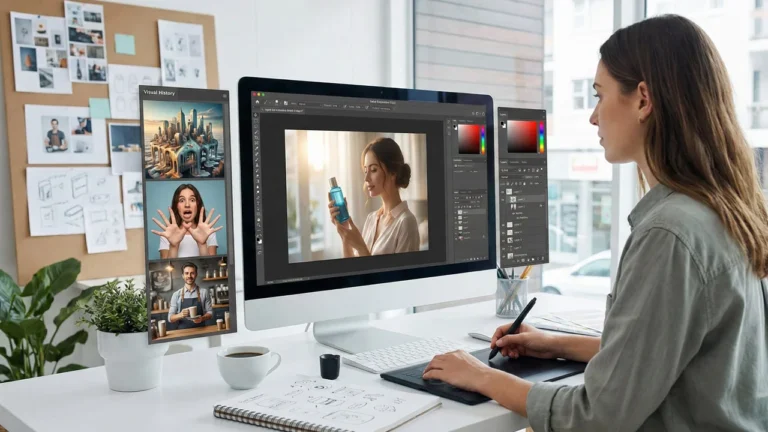
AI Editable Stock has finally conquered the creative’s biggest adversary: the empty page. For as long as we’ve been making art, the blank canvas has been intimidating, demanding something from nothing. It requires you to translate a vague, nebulous feeling into visual reality, often while fighting the limitations of your own hand or software.
Table of Contents
But in the last few years, the ground has shifted beneath our feet. We aren’t just upgrading our paintbrushes anymore; we are changing the physics of how we create. The introduction of the AI image generator into the mainstream design workflow hasn’t just sped things up—it has fundamentally altered the relationship between “idea” and “execution.”
We are moving from an era of construction—where every pixel had to be placed manually—to an era of curation, where the artist acts more like a director, guiding a powerful engine to manifest visions that were previously impossible to render on a deadline.
The Shift from Manual to Semantic
To understand where we are going, we have to look at how we used to work. Ten years ago, if you wanted a surreal image of a cyberpunk city melting into a Renaissance painting, you needed a very specific set of skills. You needed to understand lighting engines, 3D modeling, texture mapping, and advanced compositing in Photoshop. It was a technical barrier that kept many creative minds from executing their wildest ideas.
Today, the barrier to entry has lowered, but the ceiling for creativity has risen. The process has become semantic. We now speak to our tools. We use language—prompts, parameters, and negative weights—to describe the output.
This doesn’t mean the human element is gone; it’s just different. The skill set has migrated from “how do I draw a hand?” to “how do I articulate the feeling of isolation in a crowded room?” When you set out to create AI art, you are engaging in a dialogue with a database of human visual history. The machine connects the dots, but you have to tell it which dots matter.
However, this new power came with a frustrating catch.
The “Slot Machine” Problem
For the first wave of generative AI users, the experience felt a bit like pulling the lever on a slot machine. You typed a prompt, hit “generate,” and hoped for the best. Sometimes you get a masterpiece. Sometimes you have a nightmare with seven fingers and three eyes.
For professional designers, this randomness was a dealbreaker. A marketing director doesn’t want “something cool”; they want a specific woman, looking left, holding a blue bottle, with soft morning lighting. If the AI generates the perfect woman, but she’s holding a red bottle, and you try to regenerate it, the AI might give you the blue bottle, but completely change the woman’s face.
This lack of consistency and control kept AI relegated to the “concept art” phase for a long time. It was great for mood boards, but terrible for final production assets. Designers found themselves spending hours in Photoshop trying to fix the weird artifacts AI left behind, often wondering if it would have been faster to just buy a stock photo in the first place.
The Missing Link: Editability
This is where the industry is finally maturing. We are moving past the novelty phase of “look what the robot drew” and into the utility phase of “how do I actually use this in a client project?”
The holy grail for designers isn’t just generation; it is manipulation. We need assets that aren’t flattened JPEGs, but layered, flexible components that can be tweaked. This is the gap that new platforms are rushing to fill.
Imagine generating an image where the lighting is separate from the texture, or where the subject is distinct from the background. This concept of AI editable stock images is the bridge between the chaos of generative AI and the precision of professional design.
Tools that offer this level of control are changing the game because they treat AI generations not as finished paintings, but as raw materials. Platforms like Woopicx are stepping into this space, understanding that for a designer, an image is never “done” until the client says it’s done. The ability to go back and tweak a specific element without destroying the rest of the composition is what turns a toy into a tool.
Speed vs. Soul
There is a lingering fear, often discussed in hushed tones in design agencies, that AI will suck the soul out of creativity. If everyone can generate a polished image in seconds, does skill still matter?
The answer is yes, but the definition of skill is evolving.
Think of photography. When the camera was invented, painters panicked. They thought art was dead because a machine could capture reality instantly. But art didn’t die; it changed. Painters stopped trying to be photocopiers and started inventing Impressionism, Cubism, and Abstract Expressionism. The camera liberated them from the burden of realism.
AI is doing the same for designers. By handling the heavy lifting of rendering, lighting, and texture, it frees the creative mind to focus on higher-level concepts: composition, storytelling, and emotional impact.
The danger isn’t that AI will replace artists; it’s that it will replace lazy artists. The designers who thrive in this new world will be the ones who use these tools to iterate faster, exploring fifty different directions in the time it used to take to mock up one. They will use AI to handle the tedious parts of the job—like extending a background or removing a blemish—so they can spend their energy on the “big idea.”
The Practical Workflow
Let’s look at a real-world scenario. You are designing a website for a boutique coffee brand. In the old world, you had two choices: organize an expensive photoshoot or scour traditional stock photo sites for hours, eventually settling for a generic image of a barista that five other coffee shops are also using.
In the AI-augmented workflow, the process looks different.
- Ideation: You use an AI image generator to brainstorm moods. “Dark roast aesthetic,” “steampunk coffee shop,” “minimalist morning.” You generate dozens of variations to see what sticks.
- Refinement: You pick a direction. You generate specific assets. But instead of accepting the flat image, you look for tools that give you layers or vectors.
- Customization: You take these AI editable stock images and tailor them. You change the color of the mug to match the client’s hex code. You swap the background from a blurry cafe to a solid color for the hero section.
- Final Polish: You add the human touch—typography, layout, and brand voice.
The result is something that is custom-tailored to the client, achieved at a fraction of the cost of a photoshoot, but with significantly more soul and specificity than generic stock photography.
The Future is Hybrid
We are heading toward a hybrid future. The distinct line between “I made this” and “the AI made this” is going to blur until it vanishes. Photoshop already has AI built into its cropping tools. Video editors have AI color grading.
The designers of the future will be conductors of an orchestra of algorithms. They will need to have a keen eye for curation, a deep understanding of visual language, and the technical know-how to manipulate the output.
Platforms like Woopicx represent a glimpse into this future—a place where the rigid constraints of stock photography meet the fluid possibilities of AI. It acknowledges that while AI is good at dreaming, humans are the ones who need to do the editing, the refining, and the final delivery.
In the end, creativity isn’t about how hard you worked to make the image; it’s about how the image makes the viewer feel. If AI tools help us reach that emotional resonance faster and more effectively, then they aren’t the enemy of art. They are simply the newest, most powerful brushes in the box. The canvas may no longer be blank, but what we paint over it is still entirely up to us.
